Most businesses do not think about the environmental cost of their business card programme. They just reorder when the stock runs low.
But multiply one professional's annual paper card usage across a team of twenty, and the numbers become harder to ignore. Two print runs each per year. Twenty people. That is forty separate print batches, each using paper stock, ink, packaging, and delivery. Most of those cards end up in landfill within days of being handed out.
The eco-friendly benefits of NFC business cards become most significant when you look at them at team scale, not just as an individual upgrade. One card per person. Updated digitally whenever details change. No reprinting. No waste. No recurring environmental cost.
The eco-friendly benefits of NFC business cards include the elimination of repeated paper print cycles across an organisation, the removal of ink and chemical waste from production, the option to use sustainably sourced materials including bamboo, wood, and biodegradable composites, and the reduction in packaging and delivery emissions associated with frequent reordering. When adopted across a team, these benefits compound into a measurable environmental saving that individual card use alone does not fully capture.
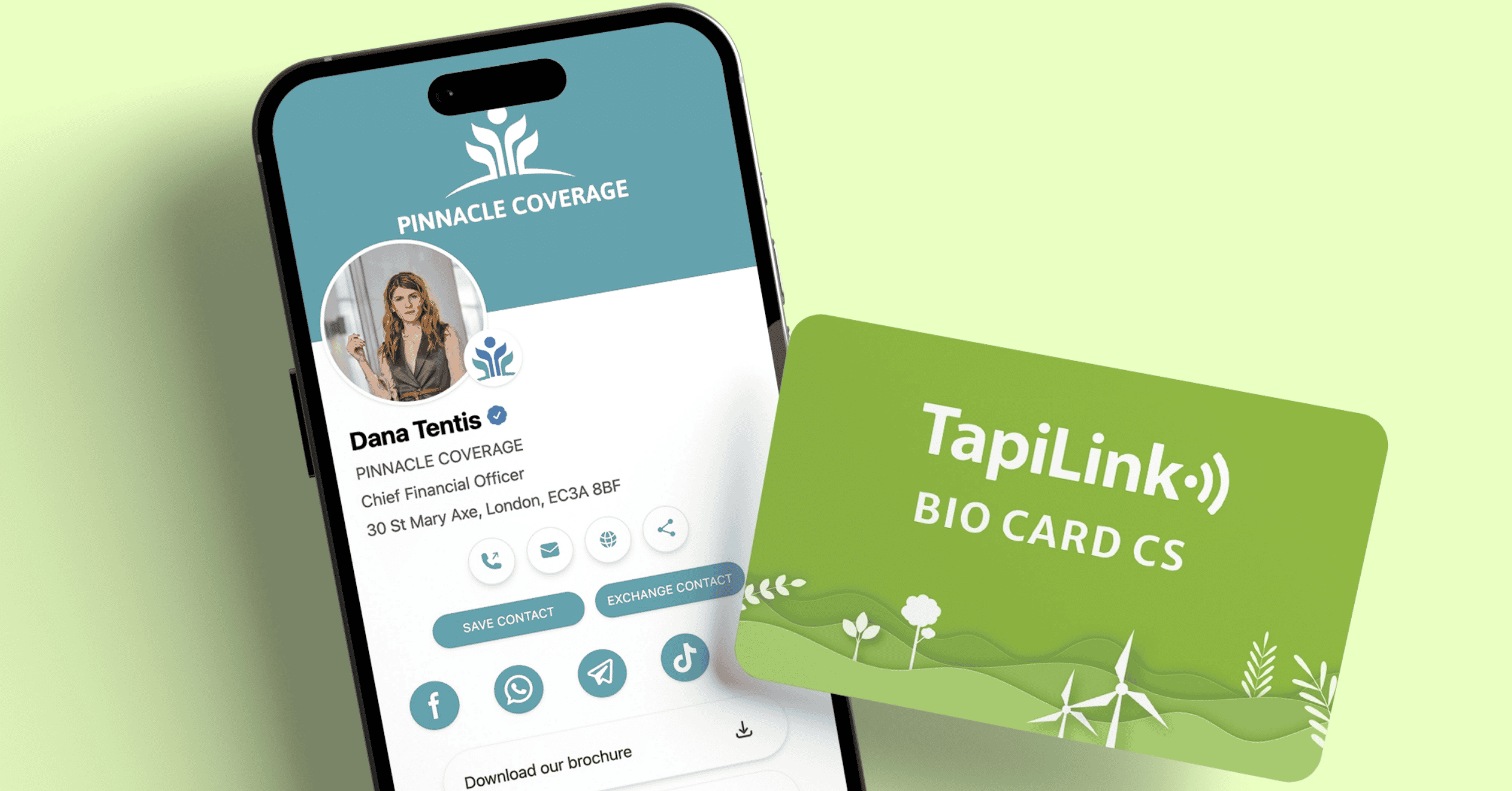
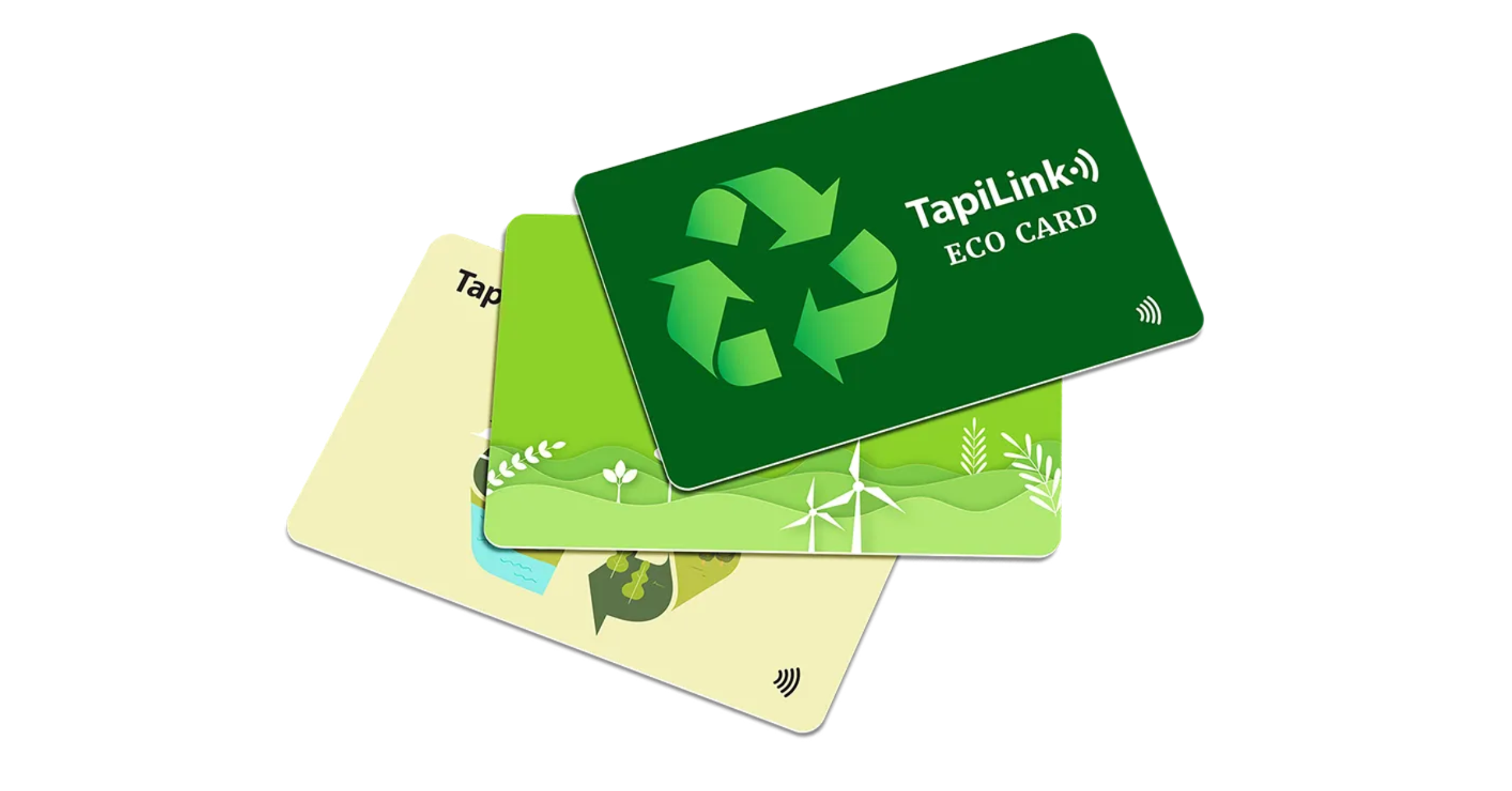
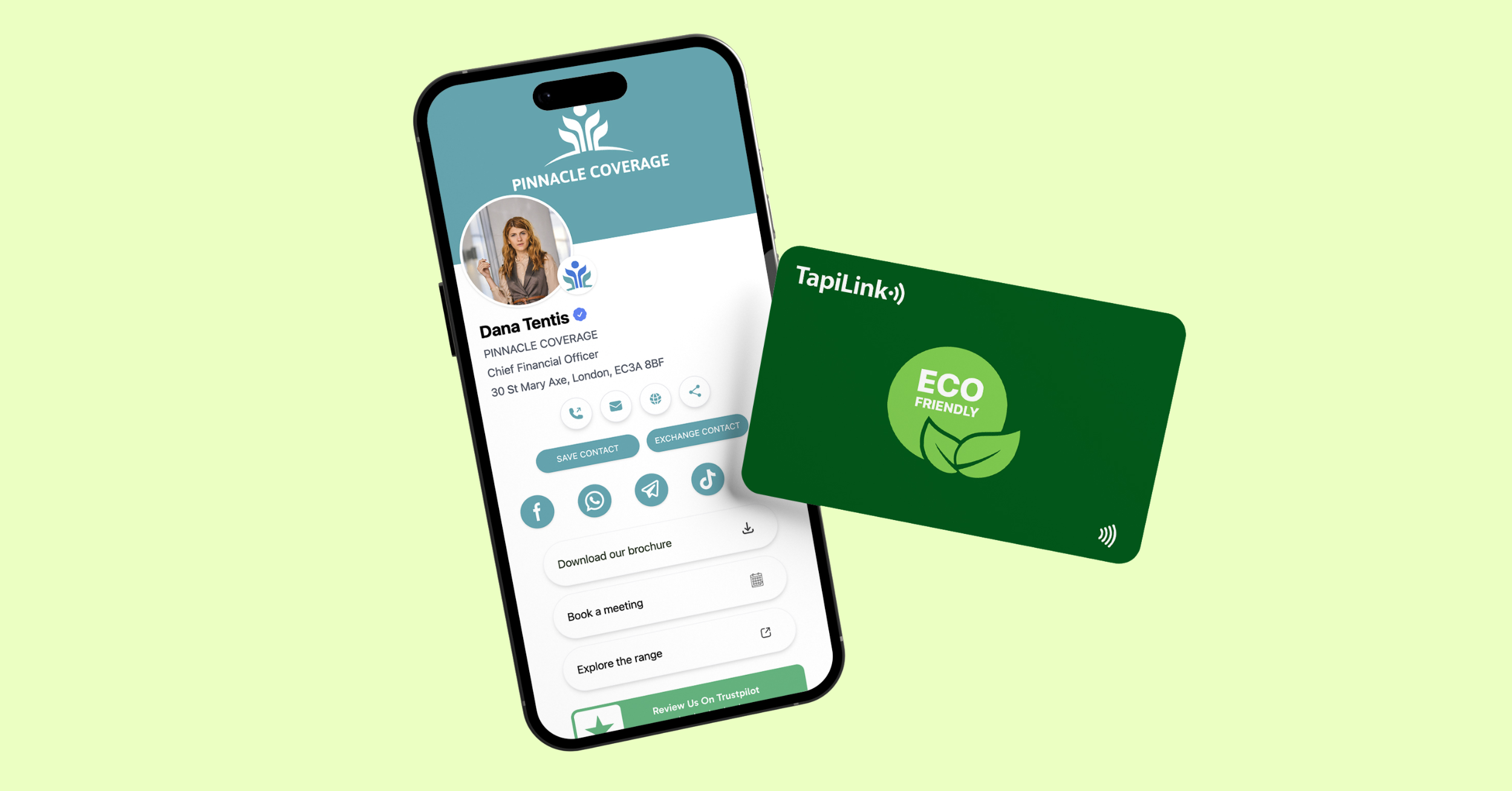
At TapiLink, we supply eco-friendly NFC business cards to UK businesses, teams, and organisations that take their sustainability commitments seriously. Our bamboo, wooden, and biodegradable card options carry the same NFC and QR functionality as our full range, with materials chosen to minimise environmental impact at every stage from production to end of life. We also plant a tree with every order placed.
In this blog, we'll cover why team-scale paper card use is a bigger environmental problem than most businesses realise, the specific eco-friendly benefits of NFC cards and their materials, how to calculate the environmental saving for your team, and what eco NFC cards signal to clients and procurement teams.
Why Businesses Are Rethinking the Business Card
The shift away from paper business cards is not just about convenience or technology. For a growing number of UK businesses, it is about being able to account for their environmental impact in a way that holds up to scrutiny.
The Scale of Paper Waste When a Team Uses Paper Cards
A single professional reprinting paper cards twice a year generates roughly 1,000 cards annually. The majority of those cards go to landfill within days. Scale that across a team of twenty and you have 20,000 cards produced and discarded every year.
88% of paper business cards are thrown away within 24 hours of being received. That pattern holds regardless of the quality of the card, the design, or the professional handing it over. The card is taken out of politeness and discarded at the earliest opportunity. Twenty thousand cards a year, nearly all of them binned.
The paper stock, ink, UV coating or laminate, packaging, and delivery logistics of each print run represent a real and recurring environmental cost. Not catastrophic in isolation. But consistent, avoidable, and entirely unnecessary once an alternative exists.
What UK Sustainability Commitments Mean for Business Purchasing
UK businesses operating under net zero commitments, corporate social responsibility frameworks, or supply chain sustainability requirements are under increasing pressure to identify and reduce avoidable waste. The UK Government's net zero strategy, documented on gov.uk, sets targets that filter through to how larger organisations evaluate their suppliers and their own operational choices.
Business stationery, including printed cards, falls within the category of operational waste that sustainability audits increasingly scrutinise. Switching a team from paper cards to eco NFC cards is a concrete, documentable action. It is not the biggest environmental lever a business can pull. But it is visible, verifiable, and easy to implement.
For businesses responding to client sustainability questionnaires or building a credible CSR narrative, this kind of practical, measurable change matters more than it might appear.
The Core Eco-Friendly Benefits of NFC Business Cards
The environmental case for NFC business cards rests on three specific mechanisms. Each one is straightforward. Together they produce a meaningful outcome.
Eliminating Repeat Print Cycles Across an Entire Team
This is the most significant eco benefit and the one most businesses underestimate until they calculate the numbers for their own team.
Every time a team member changes their job title, phone number, email address, or social media handle, a paper card becomes incorrect. With paper, the options are to keep handing out wrong information, hand-write corrections on the card, or reprint. Most organisations reprint.
An NFC card with a dynamic profile eliminates this cycle entirely. The physical card stays exactly as produced. The profile updates online. Every future tap shows the correct, current information. No new card, no new packaging, no new delivery, no discarded batch.
For a team of twenty across a two-year period, that saving could represent dozens of prevented print runs. The environmental arithmetic is straightforward once you do it.
No Ink, No Chemicals, No Laminate Waste
Standard paper business card production uses petroleum-based inks in most cases. Premium finishes add UV coatings and laminates. Both of these additions make the card non-recyclable, even when the paper stock underneath could otherwise be processed through standard paper recycling.
A laminated or UV-coated paper business card goes to landfill. It cannot be recycled. It sits there for decades.
NFC cards remove this from the equation at the point of production. Bamboo cards use no UV coating. Biodegradable cards use no petroleum-based inks. Wooden cards are finished with processes that do not generate chemical waste in the same way. The one-time production of an eco NFC card is a categorically different environmental event from a print run of laminated paper cards.
One Card Per Person, Updated Digitally, Never Discarded
The dynamic profile is the environmental mechanism that makes NFC cards genuinely different from paper alternatives.
A paper card with wrong information on it has no value. It goes in the bin. A digital NFC card with outdated information on the profile gets updated in 30 seconds. The physical card retains its full value. The contact information is correct. Nothing is wasted.
For businesses where staff details change regularly, through promotions, department moves, team restructures, or rebranding, the avoided waste from dynamic profiles is ongoing. Every update that would have triggered a reprint in a paper card system instead happens silently online. The environmental saving accumulates with every change.
Eco-Friendly NFC Card Materials - What Your Team Can Choose
The material your team carries matters. Not all eco claims are equal, and understanding the differences helps businesses make the right choice for their sustainability commitments.
Bamboo NFC Cards - Renewable and Fast-Growing
Bamboo is one of the most credible sustainable materials available. It grows faster than virtually any other plant used in manufacturing, reaching maturity in three to five years compared to decades for hardwood timber. It regenerates from its own root system without replanting. It requires no pesticides under normal growing conditions.
Our Original Bamboo Digital Business Card and Matt Black Bamboo Digital Business Card use responsibly sourced bamboo stock that carries the NFC chip and QR code within a card that looks and feels premium. The natural grain visible on the surface is not a design choice. It is the material itself.
For teams where the card is a brand statement as well as a contact tool, bamboo carries a visible environmental credential that paper never can.
Biodegradable NFC Cards - What the Term Actually Means
Biodegradable is a term that requires clarification, because it gets misused regularly in product marketing.
A genuinely biodegradable business card breaks down naturally when exposed to appropriate composting or environmental conditions, leaving no persistent plastic residue. Our Bio Degradable Digital Business Card uses materials formulated to decompose without leaving microplastic contamination, which is the specific environmental concern that standard PVC card waste creates.
This matters for businesses with strong end-of-life commitments. A biodegradable card that has served its useful life, which given the durability of these materials and the dynamic profile system is many years, can be composted rather than landfilled.
For procurement teams evaluating supplier sustainability claims, the distinction between "compostable" and simply "plant-based" is increasingly important. Ask for specifics. We provide them.
Wooden NFC Cards - Sustainably Sourced and Long-Lasting
Maple, cherry, walnut, and basswood NFC cards from our NFC Wooden Digital Business Cards range use timber from managed forest sources. The cards carry FSC-equivalent sourcing credentials and are produced without the chemical finishing processes that make standard printed cards non-recyclable.
Wooden cards are also extremely durable. They resist the surface wear that affects PVC cards over months of use, and because the NFC profile updates digitally, one wooden card serves a professional for years without replacement. The longer a card lasts, the lower its lifetime environmental footprint.
For B-Corp aligned businesses, sustainability consultancies, architecture practices, and any organisation where visible environmental credentials are part of the professional identity, a wooden or bamboo NFC card is a coherent choice.
PVC Cards - The Honest Environmental Position
Not every team will choose bamboo or biodegradable. PVC digital business cards remain the most practical option for many businesses, particularly those ordering in larger volumes where cost per unit is a key consideration.
The honest environmental position on PVC: it is not biodegradable, it does not compost, and at end of life it goes to landfill. These are real limitations and we do not pretend otherwise.
But a PVC NFC card still represents a significant environmental improvement over paper cards when measured across a realistic usage period. One PVC card replacing five or six paper print runs over three years avoids the cumulative production waste of those runs, even if the card itself is not biodegradable. The net position is better. Not perfect, but meaningfully better.
For businesses where the primary goal is reducing reprint waste and the secondary goal is material sustainability, PVC is an acceptable starting point with the option to move to eco materials on the next order cycle.
The Environmental Saving at Team Scale
Individual card sustainability is one thing. What happens when you apply the same logic across an entire team is more compelling.
Calculating the Waste Avoided When a Team of Twenty Switches
Here is the calculation for a realistic UK professional team.
Twenty team members. Each reprints paper cards twice a year at 500 cards per run. That is 20,000 cards produced annually. Over three years, 60,000 cards. Each card uses paper stock, ink, coating, and packaging. Most end up in landfill. The delivery for each reprint adds additional logistics emissions.
Switch the same team to NFC eco cards. Twenty cards produced once. Dynamic profiles updated online whenever details change. No reprinting for the full three years unless a physical card is lost or damaged, which is rare given the durability of bamboo and wooden materials.
The avoided environmental cost across three years includes the paper stock for 60,000 cards, the ink and coating processes across 40 print runs, 40 sets of packaging, and 40 delivery journeys. The numbers are not astronomical. But they are real, they are avoidable, and they are the kind of specific, calculable saving that sustainability reports can actually use.
For a business with 50 or 100 staff, scale accordingly.
Eco-Friendly NFC Cards as a Corporate Sustainability Signal
The environmental benefits of eco NFC cards are not just internal. They are visible in every meeting, every introduction, and every networking moment where the card changes hands.
What Clients and Partners Notice
Hand a client a bamboo NFC card and they notice the texture before they notice the technology. The natural grain, the warmth of the material, the weight of a wooden card, these are tactile signals that precede any conversation about sustainability credentials.
For businesses where client relationships involve sustainability alignment, whether that is a consultancy pitching to a corporate client with a net zero mandate, an architect presenting to a developer with green building commitments, or a food and drink brand meeting a retailer with sustainable sourcing requirements, the card you hand over is part of the brand argument.
Nobody is going to sign a contract based on business card material. But perception accumulates from small signals, and the businesses that understand this build stronger first impressions.
Procurement, CSR Reporting, and Green Credentials
UK businesses submitting CSR reports or responding to sustainability questionnaires in procurement processes increasingly need to demonstrate concrete actions, not just intentions.
Switching a team of twenty from paper to eco NFC cards is a documentable action. The number of print runs avoided, the materials chosen, the tree planting commitment per order. These are specifics that can be included in a sustainability report with a straight face.
Forbes research on corporate sustainability consistently shows that procurement decisions at major UK organisations now include supplier sustainability evaluation as a standard component. Businesses that can demonstrate visible, practical sustainability actions perform better in these evaluations than those who have broad commitments but no specific implementations to point to.
An eco NFC card programme is small in absolute terms. But it is concrete, verifiable, and reproducible across the organisation.
Conclusion
The eco-friendly benefits of NFC business cards are real, specific, and scale significantly when applied across an organisation rather than just an individual.
Switching a team from paper cards to eco NFC cards removes a recurring cycle of production waste, avoids the chemical and laminate processes of standard print runs, and gives every team member a card that updates digitally rather than going to landfill when their details change.
TapiLink supplies bamboo, wooden, biodegradable, and standard NFC business cards to UK businesses and teams committed to making this switch. Every order includes free custom logo design, next-day UK delivery, and individual dynamic profiles for each team member. No subscriptions. No reordering. And with every order, we plant a tree.
Your team's networking tool should reflect your values. Make it count.
Explore our full range of NFC Eco-Friendly Digital Business Cards and find the right material for your team.
Frequently Asked Questions
Question: Are NFC business cards genuinely eco-friendly or is it just marketing?
Answer: The eco-friendly case for NFC business cards rests on two things: the elimination of repeated paper print cycles and the option to choose sustainable physical materials. Both of these benefits are real and measurable. A team that switches from paper to eco NFC cards avoids the production and disposal of thousands of cards over a three-year period. The claim holds up under scrutiny, particularly for bamboo and biodegradable options where the material itself carries independently verifiable environmental credentials.
Question: What is the most eco-friendly type of NFC business card available in the UK?
Answer: Bamboo and biodegradable NFC cards carry the lowest environmental footprint at both production and end-of-life stages. Bamboo grows rapidly and regenerates without replanting. Biodegradable cards break down naturally without leaving microplastic residue. Wooden cards from sustainably managed forests are a close alternative with superior durability. All three options are significantly better than paper cards when measured across a realistic usage period.
Question: How much paper waste does switching to NFC cards actually save for a business team?
Answer: For a team of twenty professionals who would otherwise reprint paper cards twice a year, switching to NFC cards avoids approximately 20,000 paper cards annually, or 60,000 over three years. That saving includes the paper stock, ink, coating, packaging, and delivery associated with each print run. The exact figure varies by team size and reprint frequency, but the direction is always the same: meaningful avoidance of unnecessary production waste.
Question:Can eco NFC cards be included in a company's CSR or sustainability report?
Answer: Yes. The switch from paper card programmes to eco NFC cards represents a concrete, documentable sustainability action. The number of print runs avoided, the materials selected, and any tree-planting commitments from the supplier can all be cited specifically. For businesses submitting sustainability questionnaires to clients or procurement teams, this kind of specific, verifiable action carries more weight than general environmental commitments without evidence.
Question:Do bamboo and wooden NFC cards work on all smartphones?
Answer: Yes. The NFC chip and QR code in bamboo, wooden, and biodegradable cards function identically to those in standard PVC cards. They work on all iPhones from the 7 onwards and the vast majority of Android devices from the past five years. No app is required on the receiving device. The profile opens in the phone's browser the moment the card is tapped or scanned.
Ready to revolutionize your networking approach? Explore TapiLink's range of premium NFC business cards and join the thousands of professionals who've already made the smart choice.