Seven million trees are cut down every year to produce business cards globally. The vast majority of those cards end up in landfill within 24 hours of being handed over.
That is not a fringe concern. That is a structural waste problem built into the way professionals have exchanged contact details for decades. The environmental benefits of digital business cards are significant, measurable, and increasingly relevant to UK businesses that take their sustainability commitments seriously.
The environmental benefits of digital business cards include the elimination of paper waste from repeated print cycles, the removal of ink and chemical use in production, the reduction in delivery-related carbon emissions from reprints, and the option to use sustainable physical materials such as bamboo, wood, and biodegradable alternatives. One digital card replaces dozens of paper print runs over its lifetime, making it a meaningfully lower-impact networking tool.
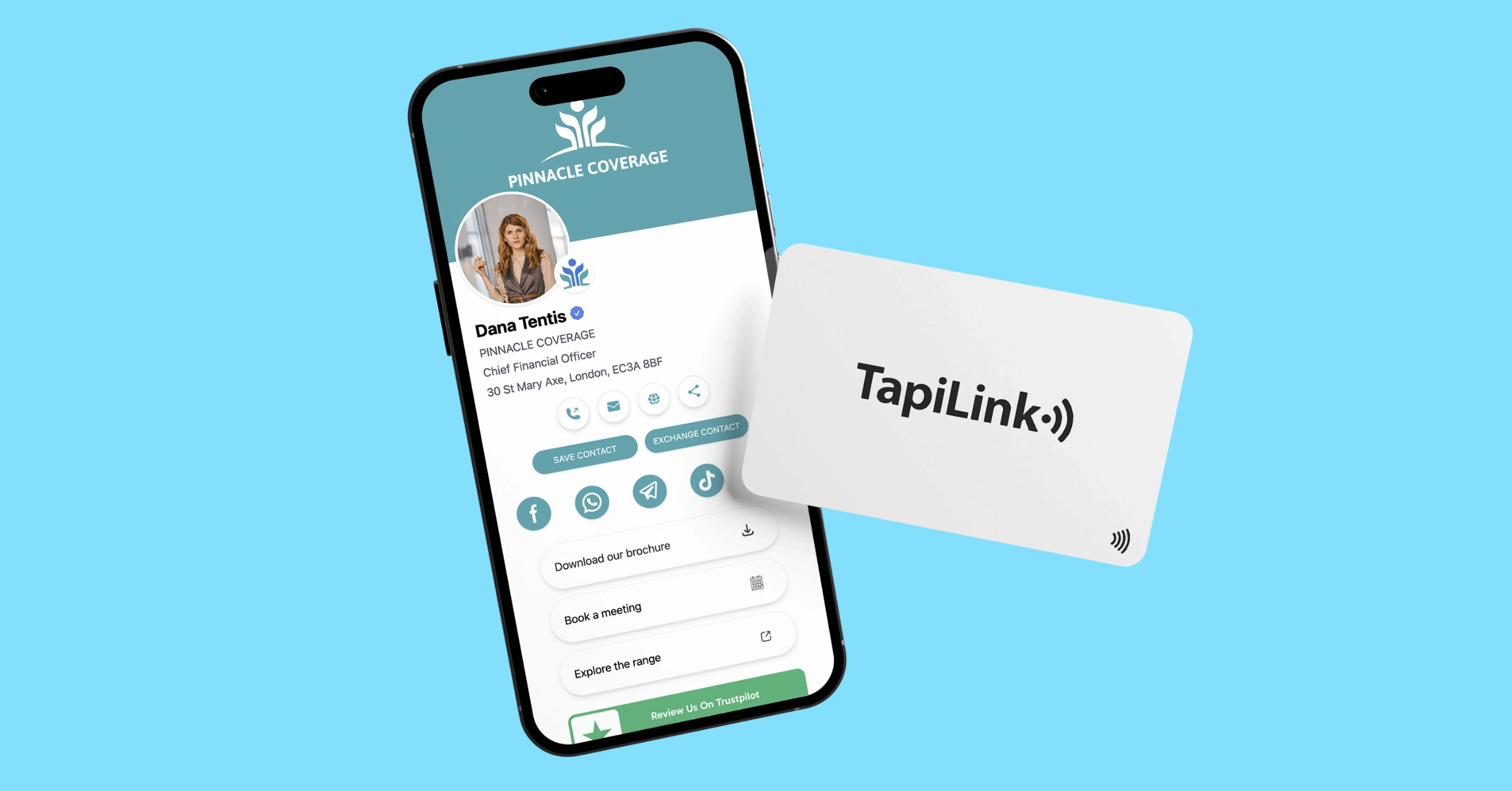
At TapiLink, we produce NFC and QR hybrid digital business cards from a range of materials, including bamboo, sustainably sourced wood, and biodegradable options. Every card we sell comes with a dynamic profile that never needs reprinting. We also plant a tree with every order. The environmental case for switching is built into everything we make.
In this blog, we'll cover the real scale of the paper business card waste problem, break down the specific environmental benefits of going digital, look honestly at material choices, and explain why UK businesses are using this shift as a brand signal.
The Paper Business Card Problem - What the Numbers Actually Show
Before making the case for digital, it helps to understand the actual scale of what paper cards cost the environment. Most people underestimate it.
How Much Paper Waste Do Business Cards Create?
Around ten billion paper business cards are printed globally every year. That figure comes from industry print data tracked by Statista and print market research bodies. Ten billion cards. Printed, distributed, and in most cases discarded within days.
88% of paper business cards are thrown away within 24 hours of being received. That statistic is not an exaggeration of occasional behaviour. It is the norm. The card goes in the pocket, then the drawer, then the bin.
Each tonne of paper produced requires roughly 24 trees, significant volumes of water, and energy-intensive processing. Scale that across the global business card print market and the numbers become uncomfortable quickly.
The UK alone has hundreds of thousands of small businesses, freelancers, and professionals who print cards regularly. Most reprint at least twice a year as details change. That is a continuous cycle of production and disposal with almost no retention rate at the other end.
The Hidden Environmental Cost of Reprinting
This is the part the paper card industry does not advertise.
A single print run looks manageable. Five hundred cards, perhaps £40 spent, delivered in a few days. The environmental cost of that run includes the paper stock, the ink, the printing process, the packaging, and the courier delivery. Multiplied across an active professional career, the cumulative impact is significant.
But the reprint cycle is where the real damage compounds. Change your job title. Reprint. Get a new phone number. Reprint. Rebrand. Reprint. Every old batch discarded is a full production and waste cycle that achieved nothing.
A digital card breaks that cycle entirely. One card, produced once, updated indefinitely.
The Environmental Benefits of Digital Business Cards Explained
The case is straightforward but worth stating clearly, because the benefits stack up across several different environmental categories, not just paper.
Eliminating Paper Waste at the Source
The most direct environmental benefit of digital business cards is the simplest one. No paper is used. No trees are cut for the stock. No paper ends up in landfill after the contact fails to use the card.
That matters more than it sounds. Paper waste is one of the most significant contributors to municipal solid waste in the UK, and business cards contribute to that category in a way that is almost entirely avoidable.
A single digital card, used by an active networker over three years, replaces an estimated six to eight paper print runs. For a small business buying cards for a team of ten, that saving across three years represents tens of thousands of individual cards that never get printed, never get binned, and never reach landfill.
Cutting the Carbon Cost of Print and Delivery
Paper production is carbon-intensive. Printing adds more. Packaging and courier delivery of each new batch adds more still.
Every reprint cycle generates a small but real carbon cost. Multiply that across the lifetime of an active professional and it accumulates meaningfully. Digital cards eliminate every reprint delivery. The profile updates online with no physical production or logistics involved.
For businesses working toward net zero targets or reporting under the UK Government's sustainability frameworks, removing unnecessary reprint cycles is a small but genuine contribution to reducing operational emissions.
No Ink, No Chemicals, No Landfill
Standard paper business card printing uses petroleum-based inks. Some use UV coatings and laminates that make the cards non-recyclable even when the paper stock itself could otherwise be recycled.
A laminated, UV-coated paper card cannot go in the recycling bin. It goes to landfill. Every time.
Digital cards avoid this entirely. The physical card, whether bamboo, wood, or biodegradable material, is produced once with no ongoing ink or chemical use. And the right material choice makes the physical card itself far more environmentally sound than anything coming out of a standard print run.
Not All Digital Cards Are Equal - Material Matters
Here is where it gets more nuanced. Digital does not automatically mean eco-friendly. The physical card still exists, still requires production, and its environmental credentials depend entirely on what it is made from.
Bamboo and Wood - The Renewable Alternative
Bamboo is one of the most sustainable materials available for card production. It grows faster than almost any other plant, requires no pesticides, regenerates without replanting, and produces a strong, attractive surface for engraving and NFC embedding.
Our Original Bamboo Digital Business Card uses bamboo stock that is responsibly sourced. The result is a card that looks and feels premium, carries the full NFC and QR functionality, and has a genuinely lower environmental footprint than any paper alternative.
Wooden cards made from maple, cherry, walnut, and basswood offer similar credentials when sourced from managed forests. The grain, the weight, and the tactile quality of a wooden card also make a strong impression. Our NFC Wooden Digital Business Cards range covers all of these finishes, each with the same dynamic profile capability.
Biodegradable Cards - What They Actually Mean
Biodegradable is a word that gets used loosely in product marketing. Worth being clear about what it actually means for business cards.
A genuinely biodegradable business card breaks down naturally when composted or exposed to the right environmental conditions, leaving no persistent plastic residue. Our Bio Degradable Digital Business Card uses materials designed to decompose without leaving microplastic contamination. That is a meaningful distinction from standard PVC, which persists in the environment for hundreds of years.
For businesses that want to make the strongest possible environmental statement with their networking tools, biodegradable is the right choice. The card works identically from a technology standpoint. Tap or scan. Profile opens. Connection made. The difference is entirely in what happens at end of life.
PVC Cards - The Middle Ground
PVC cards are not biodegradable. But they last significantly longer than paper, require no reprinting, and in terms of lifetime environmental impact, one PVC digital card still compares favourably to six or eight paper print runs.
Our NFC PVC Digital Business Cards are the most popular choice for everyday professional networking where durability and cost are the primary considerations. They are not the most eco-friendly option in our range. But they are substantially better than paper when measured across a realistic usage period.
The honest position is this: if environmental credentials are your priority, choose bamboo, wood, or biodegradable. If your priority is durability and value, PVC still represents a net environmental improvement over paper.
Sustainability as a Brand Signal for UK Businesses
The environmental benefits of digital business cards are not just internal. They are visible to clients, partners, and procurement teams in ways that matter commercially.
What Eco-Conscious Clients Actually Notice
Hand a prospective client a bamboo NFC card and they notice the material before they notice the technology. The texture, the warmth, the visible grain - it signals something about your values before a word is exchanged.
For businesses working in sectors where sustainability is front of mind, whether that is architecture, consultancy, wellness, B-Corp-certified brands, or any business pitching to environmentally conscious corporate clients, the card you hand over is part of your brand argument.
It is a small thing. But small things accumulate in the perception a client forms about your business.
Green Credentials and B2B Procurement
UK businesses operating within corporate supply chains increasingly face sustainability questionnaires as part of procurement processes. Reducing unnecessary waste, including print waste, is a legitimate and measurable contribution to those frameworks.
The UK Government's net zero commitments, detailed under the Environment Act and related policy guidance on gov.uk, place increasing pressure on businesses to identify and reduce avoidable waste in their operations. Switching from paper card print cycles to digital cards is a concrete, documentable step in that direction.
It will not make or break a sustainability audit. But it is the kind of visible, practical commitment that demonstrates a business takes its environmental responsibilities seriously rather than treating them as a box-ticking exercise.
Why UK Businesses Are Choosing Eco Digital Cards Right Now
The timing matters. UK businesses are under more pressure than ever to demonstrate genuine sustainability action, not just intent.
Consumer expectations have shifted. Forbes research shows that a growing proportion of UK consumers actively prefer to do business with companies that demonstrate environmental responsibility. That preference influences purchasing decisions in B2C and B2B contexts alike.
And here is the thing. The switch to digital business cards costs no more than a quality paper print run. Often less, once you factor in the reprints you are not doing. The environmental benefit is real. The commercial signal is positive. The practical networking advantage is significant.
For a UK small business owner making a decision about their networking tools in 2026, the argument for eco digital cards is not close. It is clear.
We plant a tree with every TapiLink order. That is not a marketing line. It is a commitment we make on every single transaction, because we believe businesses that care about their environmental impact should work with suppliers who feel the same.
The Full Environmental Picture - Digital Cards Are Not Perfect, But They Are Better
A fair account of the environmental benefits of digital business cards has to acknowledge the full picture.
NFC chips contain small amounts of metal and electronic components. No manufacturing process is zero-impact. Shipping a card from production to delivery has a carbon cost. These things are real.
But the comparison is not between a digital card and nothing. It is between a digital card and a recurring cycle of paper production, ink, packaging, delivery, and landfill disposal, repeated multiple times across a professional's working life.
Measured across a realistic usage period of three to five years, one digital card produces a fraction of the environmental impact of the paper alternative it replaces. The more reprints the paper card would have required, the more significant the saving becomes.
For bamboo and biodegradable options, the end-of-life impact is also meaningfully lower. The card does not persist in landfill for decades. It breaks down. That matters.
The businesses that care about getting this right choose the most sustainable material available to them, use the card for as long as possible, and make the switch part of a broader commitment rather than an isolated gesture. That is the right approach. And it starts with making the switch.
Conclusion
The environmental benefits of digital business cards are not theoretical. They are measurable, repeatable, and scale with every professional who makes the switch.
Paper card print cycles generate waste, consume resources, and repeat indefinitely. A single digital card breaks that cycle for good.
TapiLink produces NFC and QR hybrid digital business cards from bamboo, sustainably sourced wood, biodegradable materials, and PVC, for UK professionals and businesses that want networking tools aligned with their values. Every card comes with a dynamic profile you update yourself, free custom design, and next-day UK delivery. And with every order, we plant a tree.
The professionals who make this switch are not just saving money on reprints. They are making a choice about the kind of business they want to be.
Browse our full range of NFC Eco-Friendly Digital Business Cards and find the card that fits both your brand and your values.
Frequently Asked Questions
Question: Are digital business cards actually better for the environment than paper?
Answer: Yes, measured across a realistic usage period. A single digital card replaces multiple paper print runs over its lifetime, eliminating the paper stock, ink, chemicals, packaging, and delivery emissions associated with each reprint. The environmental advantage is most significant for active networkers who would otherwise reprint paper cards regularly as their details change. Choosing bamboo or biodegradable materials increases the benefit further.
Question: What is the most eco-friendly type of digital business card?
Answer: Bamboo and biodegradable digital business cards carry the lowest environmental footprint. Bamboo is a rapidly renewable material that requires no pesticides and regenerates without replanting. Biodegradable cards break down naturally at end of life without leaving microplastic residue. Both options carry the same NFC and QR functionality as standard cards, with a meaningfully better environmental profile.
Question: Do digital business cards contribute to a business's sustainability credentials?
Answer: Yes. Eliminating paper print cycles reduces operational waste and associated carbon emissions. For businesses reporting under UK sustainability frameworks or responding to corporate procurement sustainability questionnaires, switching to digital cards is a concrete, documentable step. It also serves as a visible brand signal to eco-conscious clients, partners, and collaborators.
Question: How many paper cards does one digital business card replace?
Answer: This depends on how frequently the professional reprints. An active networker who reprints twice a year as details change would replace approximately six to ten paper print runs over five years with a single digital card. For a small business buying cards for a team of ten, that saving across five years represents tens of thousands of individual cards that never reach landfill.
Question: Are NFC chips in eco-friendly cards safe for the environment?
Answer: NFC chips contain small amounts of metal and electronic material and are not biodegradable themselves. However, they are produced once and embedded permanently within the card, generating no ongoing electronic waste during the card's working life. Compared to the repeated production and disposal cycle of paper cards, the net environmental impact of an NFC chip embedded in a bamboo or biodegradable card is significantly lower over any realistic usage period.
Ready to revolutionize your networking approach? Explore TapiLink's range of premium NFC business cards and join the thousands of professionals who've already made the smart choice.